
One of ASEAN's three largest economies by nominal output, and the bloc's second-largest measured by purchasing power at roughly US$2.2 trillion.
65.8 million Thai-registered residents plus more than 5 million long-term foreign and migrant residents.
67.8 million connected users: one of Asia's most mobile-first, social-commerce mature populations.
Thailand's internet economy grew 16% year on year across e-commerce, fintech and digital services.
Thailand is not the cheapest market in Southeast Asia, but it is one where a mid-priced foreign product can sell. GDP per capita is near USD 8,000, above Indonesia and Vietnam, and the World Bank classifies the country as upper-middle income. Urban households in Bangkok, Chonburi, Rayong and Phuket already buy imported brands, subscription software and overseas services.
Connectivity is effectively universal: 94.7% of the population is online, LINE is the default business messaging channel with roughly 56 million monthly users, and TikTok Shop has become one of the country's fastest commercial channels. The strategic caveat a foreign entrant must plan around is demographics: more than 20% of Thai residents are now aged 60 or over, so categories that skew young face a flattening funnel while health, premium consumer, and B2B industrial demand keep expanding.

Thailand's Board of Investment has used incentives to pull record commitments into advanced manufacturing and digital infrastructure, mostly in the Eastern Economic Corridor.
BOI-approved investment applications reached THB 1.88 trillion (~US$60 billion) across 3,370 projects in 2025, after a 35% jump to THB 1.14 trillion in 2024. Promoted companies receive corporate tax exemptions of 8 to 13 years and, critically, 100% foreign ownership.
Google committed USD 1 billion to a Thailand data centre and cloud region, Amazon Web Services more than THB 190 billion (~US$5 billion) over 15 years with its Asia Pacific (Thailand) region now live, and Microsoft roughly USD 1 billion: creating local hyperscale demand for enterprise services.
Purchase subsidies of up to THB 100,000 per battery-electric vehicle are tied to local production, converting Thailand into Southeast Asia's leading EV hub. BYD opened its first Southeast Asian plant in Rayong in July 2024, with Chinese OEM capacity following.
Around USD 26.8 billion of chip, board and advanced-electronics investment has been filed through BOI, part of roughly 880 high-tech projects submitted between 2023 and mid-2026: deepening the industrial base that buys foreign enterprise software, tooling and components.
The Eastern Economic Corridor concentrates most of Thailand's state capital: deep-sea port capacity, an aviation city, and the first standard-gauge high-speed rail line.
Thailand's main container gateway is adding 7 million TEU of annual capacity, with land reclamation past 82% in late 2025 and Terminal F1 scheduled to open in 2027.
A THB 217.9 billion public-private build-out (THB 24.7 billion state, THB 193.3 billion private) turning U-Tapao into a cargo, maintenance and airport-city hub sized for 70 million passengers a year by 2048.
Thailand's first 253 km high-speed line is more than half built, with completion targeted around 2030 and a north-eastern extension planned toward Nong Khai and the Lao border.
A roughly THB 1 trillion (~US$30 billion) twin-port and rail-link concept across the Kra isthmus. Approved in principle only: environmental and feasibility work continues, with no construction start and no firm operating date; the earliest discussed operation is around 2030.
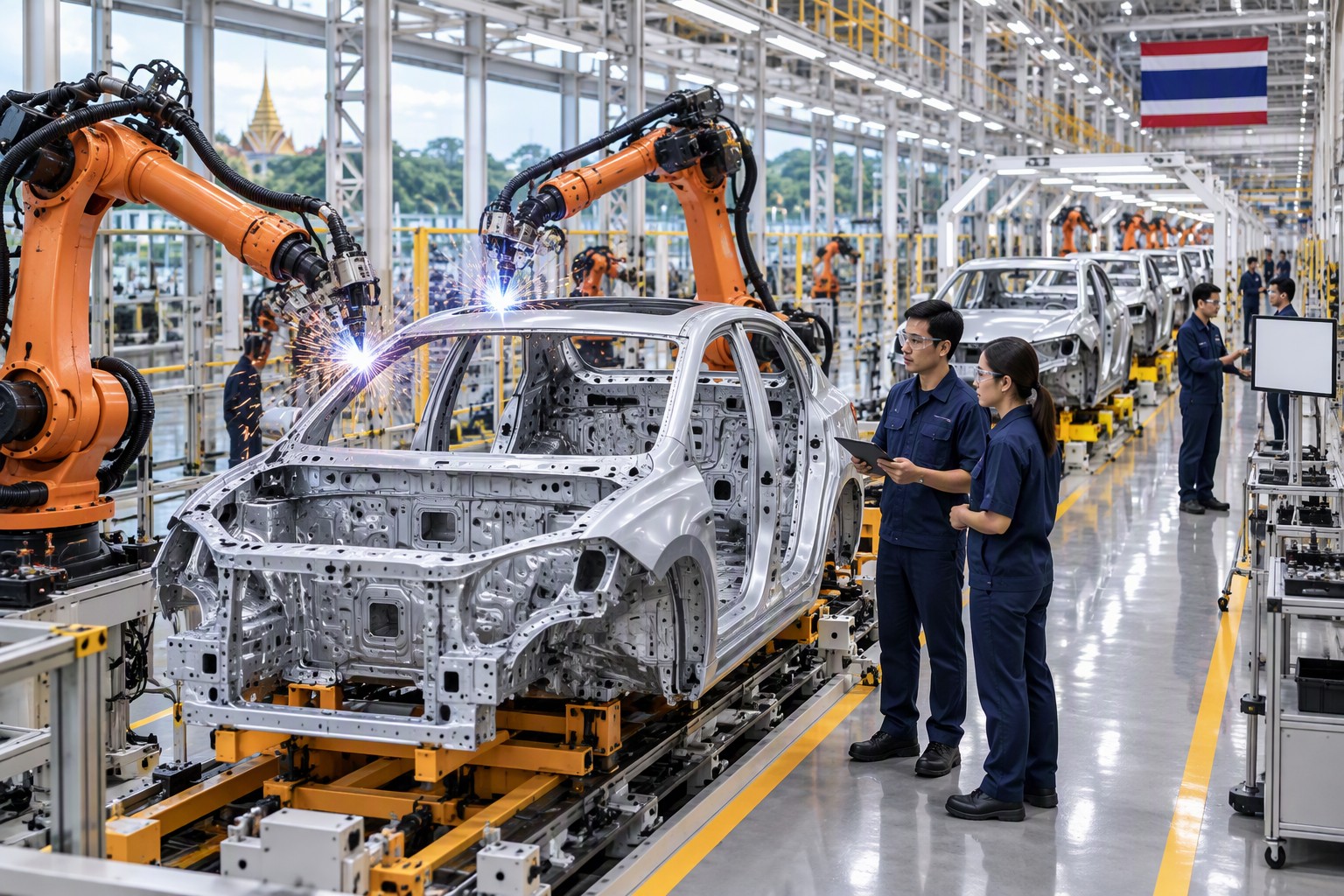
Thailand remains Southeast Asia's largest vehicle production base and its top EV assembly hub, alongside integrated electronics, printed circuit boards, processed food and rubber. That industrial density is what foreign B2B sellers are really buying into: thousands of plants that need components, software, compliance services and technical support.
Abadi Guru can run local prospecting and closing as your appointed agent, or staff customer operations from Batam. Either way, you reach this market without incorporating a Thai entity or taking on local employment liability.
With our BPO teams or an appointed marketing agent, you can test and sell in Thailand without registering a Thai entity or taking on employment liability, with local-language commercial support.
Under the Foreign Business Act B.E. 2542 (1999), most service businesses fall under List 3 and require a Foreign Business License that normally caps foreign equity at 49%. Only BOI-promoted companies reliably obtain 100% foreign ownership.
Each foreign work permit generally requires THB 2 million of paid-up capital and four Thai Social-Security-listed employees per foreign worker: a real cash and headcount burden before a single baht of revenue.
Mass-market and government selling is conducted in Thai, and direct hiring brings statutory severance of 30 to 300 days' pay by tenure under the Labour Protection Act, plus Workmen's Compensation and 5% Social Security Fund obligations.
Compare Thai incorporation and foreign business licensing with appointing us as your agent.
| Evaluation Metric | Traditional Thai Company + FBL | Abadi Guru Appointed Agent & BPO |
|---|---|---|
| Foreign Ownership Ceiling | 49% Thai shareholding in most service categories unless a Foreign Business License or BOI promotion is granted | Not applicable: no Thai entity or foreign shareholding test |
| Minimum Capital Reality | THB 15,000 statutory minimum, but THB 2 million per foreign worker in practice for work permits | USD $0 (zero capital escrow required) |
| Time to First Invoice | 7 to 30+ days for registration, bank account, VAT filing and foreign licensing | 7 to 14 days plug-and-play launch |
| Thai Staffing Obligation | Four Thai employees per foreign work permit, plus ongoing Social Security Fund contributions | 100% managed by Abadi Guru under SLA contracts |
| Termination & Severance Risk | Personal statutory liability of registered directors, and 30–300 days' severance per employee | Zero foreign personal liability; local compliance held by us |
| Customer Acquisition & Sales | Must recruit, train and manage unproven local sales reps | We find, prospect, negotiate, and close Thai customers for you |
Thailand is ASEAN's second-largest economy and a manufacturing and EV hub. Selling there takes Thai-language marketing and reliable retention.
Reach 71 million Thai consumers through LINE campaigns, local social media and on-the-ground partner outreach.
Abadi CRM keeps lead follow-up and customer contact in one place, so repeat orders do not depend on memory.